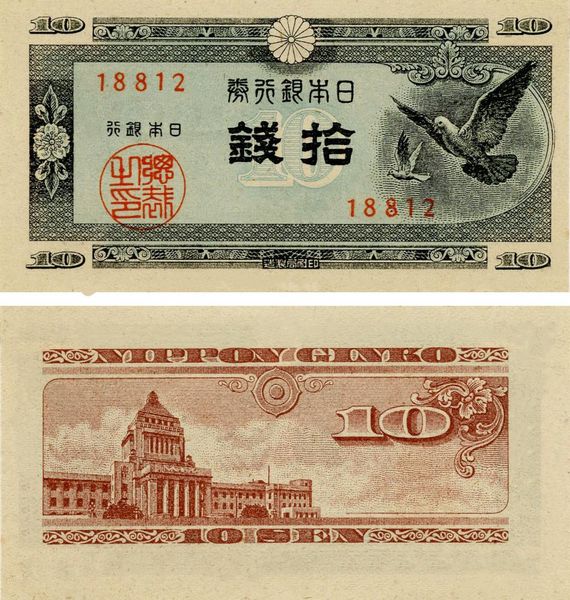
Japan 10 Sen 1947 — Doves
The 10 sen banknote was issued by the Government of Japan in 1947 (the 22nd year of Showa) and withdrawn from circulation in 1953. The final series of 10 sen notes was introduced in the post-war period amid an acute shortage of coins and rampant inflation. It is produced in black tones on a blue underprint background. The note has no security thread or watermark.
The obverse features two doves on the right and Japanese characters. The reverse depicts the National Diet Building (the Parliamentary Palace) on the left, rendered in light reddish-brown tones.
The dove is a universal symbol of peace, carrying particular significance for Japan in the post-war era. Its appearance on the 1947 note — just two years after Japan's surrender in World War II — bears deep symbolic meaning: the country was entering a period of reconstruction and democratic reform under the new Constitution of 1947. Sen-denomination banknotes were definitively demonetised at the end of 1953 in accordance with legislation that established the primacy of the yen over fractional denominations.